Beyond the 12 Brand Archetypes: Building Brands for Real Growth

Are you a Hero? An Explorer? A Creator? Maybe a Rebel?
For years, brand archetypes have helped businesses answer a simple but important question: If our brand were a person, who would it be?
It's a useful question. One that can help brands develop personalities, create emotional connections and communicate consistently.
At The Brand Leader, we used archetypes as part of our brand discovery process for years. They helped us humanize brands and shape the creative and content that brought them to life.
But as our work evolved, so did our thinking.
We realized that knowing your brand's personality is only one part of understanding its potential.
What if brand discovery could do more than define how a company looks, sounds and communicates?
What if it could help align leadership, inspire employees, connect marketing investments, strengthen customer experiences and uncover new opportunities for growth?
That's why we evolved beyond archetypes as the foundation of our brand strategy.
Not because personality doesn't matter.
Because your brand is more than a personality. It's a growth engine waiting to be unlocked.
What are brand archetypes?
Key Takeaway
Archetypes define personality, not value.
They guide voice and creative, but they don’t explain what makes a business competitive.
Brand archetypes are 12 recognizable personality types used to help define how a brand behaves, communicates and connects emotionally with its audience.
Inspired by psychologist Carl Jung's work on universal patterns of human behavior, the brand archetype framework translates familiar characteristics into distinct brand personalities.
A Hero brand might inspire achievement. A Caregiver might build trust through compassion. An Explorer might encourage independence and discovery.
These characteristics can help guide brand voice, messaging, visual identity and creative expression.
But while archetypes help explain how a brand might express itself, they don't necessarily explain what makes a business uniquely valuable, relevant or competitive.
That's where a more comprehensive approach to brand discovery becomes important.
What are the 12 brand archetypes?
Key Takeaway
Each archetype is a starting point, not a destination.
The real opportunity begins when you look past personality to what makes your business matter.
The 12 traditional brand archetypes are:
1. The Innocent
Optimistic, honest and sincere. The Innocent seeks simplicity, trust and a better world.
2. The Explorer
Independent, adventurous and curious. The Explorer values freedom, discovery and new experiences.
3. The Sage
Knowledgeable, thoughtful and insightful. The Sage seeks truth, understanding and wisdom.
4. The Hero
Courageous, determined and ambitious. The Hero inspires people to overcome challenges and achieve more.
5. The Outlaw (Rebel)
Independent, unconventional and disruptive. The Outlaw challenges expectations and embraces change.
6. The Magician
Imaginative, transformative and visionary. The Magician turns possibilities into reality.
7. The Everyman
Authentic, relatable and approachable. The Everyman values belonging, connection and shared experiences.
8. The Lover
Passionate, expressive and emotionally connected. The Lover values relationships, beauty and intimacy.
9. The Jester
Playful, spontaneous and entertaining. The Jester brings humor, joy and enjoyment to everyday life.
10. The Caregiver
Compassionate, supportive and protective. The Caregiver prioritizes helping others and making people feel valued.
11. The Creator
Inventive, expressive and original. The Creator values imagination, innovation and self-expression.
12. The Ruler
Confident, responsible and authoritative. The Ruler values leadership, stability and excellence.
Each archetype provides a useful starting point for defining a brand’s personality.
But the real opportunity begins when we look beyond personality to understand what makes a business matter.
Do brand archetypes still work?
Key Takeaway
You know your archetype. Now what?
Archetypes shape how a brand expresses itself. Discovery reveals what makes it valuable and how to grow it.
Yes. Brand archetypes can still help businesses establish recognizable personalities, create emotional connections and guide consistent communications.
But there's a difference between defining a brand personality and developing a comprehensive brand strategy.
Imagine discovering that your brand is a Hero.
Great. Now what?
Does that help your sales team articulate what makes you different?
Does it reveal why customers choose your competitors?
Does it help leadership identify growth opportunities or align employees around a shared purpose?
Does it connect your marketing, customer experience and business strategy?
Not necessarily.
And that's the distinction.
Archetypes help define how a brand expresses itself. Comprehensive brand discovery reveals what makes a business valuable and how to leverage that value for growth.
We haven't abandoned the importance of humanizing brands. We've expanded what that understanding can accomplish.
Because a compelling brand personality can make people pay attention.
A clear, differentiated and aligned brand can give them a reason to choose you, believe in you and keep coming back.
Why comprehensive brand discovery matters more than ever
Key Takeaway
Most brands don’t lack personality. They lack alignment.
When story, strategy, people and execution move together, differentiation becomes opportunity.
Most businesses don't struggle because they lack a personality.
They struggle because their story, strategy, people and execution aren't always moving in the same direction.
Leadership has a vision, but teams interpret it differently. Marketing creates awareness, but sales struggles to convert it. Customers are promised one experience but receive another. Departments invest in separate initiatives without a clear connection to a larger goal.
Individually, everyone may be doing good work.
Collectively, they're missing opportunities.
We believe the greatest value of brand discovery isn't simply uncovering what makes a company unique.
It's discovering how that uniqueness can create value across the entire business.
And that doesn't mean asking brands to become something they're not.
Quite the opposite.
It's about identifying what makes a business uniquely valuable, relevant and believable, then finding ways to leverage those strengths more effectively.
Instead of trying to be everything to everyone, we help brands focus on what makes them matter most to the people who matter most.
That's where differentiation becomes opportunity.
And where brand strategy becomes business strategy.
How our brand discovery process works: Truth. Tension. Translation.
Key Takeaway
Three stages. Clarity, opportunity and momentum.
We uncover what makes you matter, reveal what to leverage and turn it into action.
At The Brand Leader, our proprietary discovery process connects brand strategy to business opportunity and real-world execution through three essential stages.
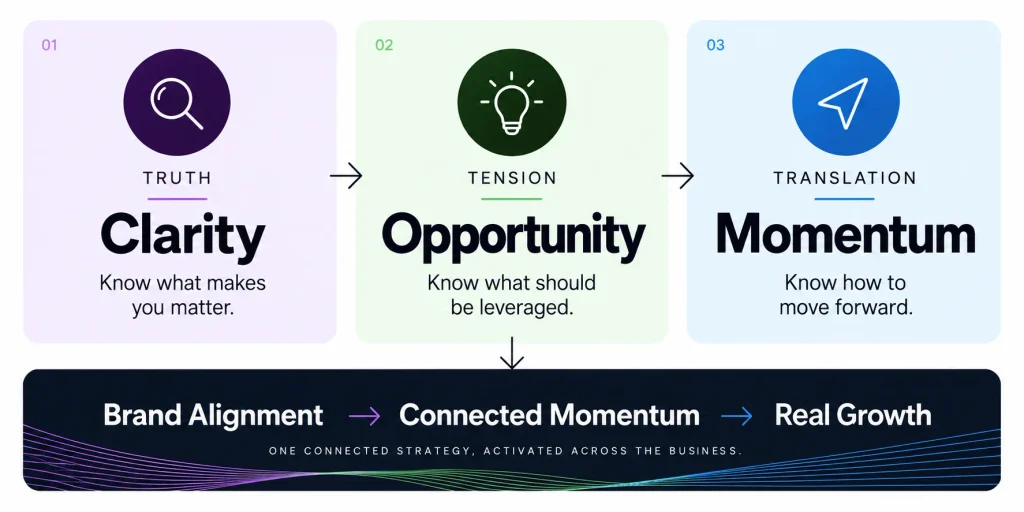
Truth. Tension. Translation.
Three connected stages designed to create clarity, uncover opportunity and build momentum.
1. Truth: Discover what makes you matter.
Every business has a truth worth discovering.
It’s found in the things a company does exceptionally well, the reasons customers choose it, the beliefs that drive its people and the value it brings to the marketplace.
But that truth isn’t always obvious, even to the people closest to the business.
That’s why we look beyond the marketing department.
We engage leadership, employees, customers and stakeholders. We explore the competitive landscape, examine market dynamics and look closely at the experiences that shape brand perceptions.
We focus on three essential realities:
- Business truth: What you do, what you believe and what you’re uniquely capable of delivering.
- Customer truth: What people genuinely need, value and expect from you.
- Market truth: Where you compete, how you’re perceived and where opportunities exist to stand apart.
The goal isn’t to manufacture a compelling brand story.
It’s to uncover the truth that makes your story worth telling.
The business benefit: Clarity.
Clarity that helps leadership prioritize. Clarity that gives employees purpose. Clarity that helps customers understand why they should choose you.
And clarity that provides a common foundation for everything that follows.
2. Tension: Reveal what should be leveraged.
Knowing what makes your business valuable is one thing.
Understanding how to make that value matter more is another.
That’s where tension comes in.
Every market has competing expectations, unmet needs and opportunities to stand apart.
Sometimes customers want something the category isn’t delivering.
Sometimes a business has exceptional capabilities that the market doesn’t recognize.
Sometimes competitors are all making similar promises, leaving an opportunity for a more distinctive and believable position.
And sometimes the greatest opportunity is already inside the business, waiting to be recognized and elevated.
Our discovery process identifies the intersection of what makes a brand unique, what customers find relevant and what the business can credibly deliver.
We look for the tension between what the market expects and what the brand is uniquely positioned to offer.
Not to reinvent the business.
But to reveal where its greatest potential already exists.
The business benefit: Opportunity.
A clearer understanding of what deserves focus, what should be amplified and where the brand can create meaningful competitive advantage.
Because growth doesn’t always require becoming something new.
Sometimes it requires going all-in on what makes you different.
3. Translation: Turn strategy into action.
This is where discovery becomes a growth engine.
A great strategy has little value if it lives in a presentation that gets referenced once a year.
It needs to become part of how a business thinks, communicates, operates and delivers.
Our translation process connects what we’ve learned to how the brand shows up in the real world.
That includes brand positioning, messaging, identity and creative expression. But it also extends into sales, marketing, customer experience, internal communications, product and service development, and organizational decision-making.
We turn strategic insights into practical direction that teams can understand, embrace and activate.
So the brand doesn’t just look and sound more consistent.
It becomes more connected in how it works.
The business benefit: Momentum.
A shared strategy that helps people make better decisions, creates consistency across customer experiences and gives marketing and communications a stronger foundation for performance.
It’s the difference between launching a new brand campaign and creating a business that consistently delivers on its brand promise.
How brand alignment creates business alignment
Key Takeaway
One shared brand. One direction for the whole business.
When every team works from the same understanding, fragmentation drops and efficiency rises.
One of the most powerful outcomes of comprehensive brand discovery is alignment.
When everyone understands what a business stands for, why it matters and where it’s going, the brand becomes a unifying force.
Leadership has a clearer foundation for decisions.
Employees understand how their roles contribute to the larger mission.
Sales teams can articulate meaningful differentiation.
Marketing teams can create more focused, effective communications.
Customer-facing teams can deliver experiences that reinforce the brand promise.
And customers encounter a business that feels consistent, credible and connected.
This is particularly valuable for growing organizations, businesses entering new markets, companies navigating change or established brands looking to strengthen their market position.
Instead of asking every department to develop its own interpretation of the brand, everyone works from a shared understanding.
The result is less fragmentation, greater efficiency and a business better equipped to deliver on its potential.
What is connected momentum, and why does it matter?
Key Takeaway
Every touchpoint should build on the last.
A shared strategy turns isolated campaigns into a connected system that gets more from every investment.
Consider how many different ways a customer might experience a brand.
They discover it through search. Encounter an advertisement. Visit a website. Read a review. Speak with a salesperson. Make a purchase. Interact with customer service. Follow the brand on social media.
Each interaction shapes their perception.
And each creates an opportunity to strengthen or weaken the relationship.
When those experiences are disconnected, businesses lose momentum. Marketing investments work independently, messages compete for attention and customers are left to connect the dots themselves.
But when they’re built around a shared strategy, each interaction can reinforce the next.
Brand strategy informs creative. Creative supports integrated communications. Communications connect across paid, earned, shared and owned channels. Sales and customer experience deliver on the expectations those efforts create.
Instead of isolated campaigns, you build a connected system.
Instead of repeatedly starting from zero, each initiative builds on the last.
That’s what we mean by connected momentum.
Not simply doing more marketing, but making everything work better together.
And when investments reinforce one another, businesses have a greater opportunity to improve efficiency, strengthen customer relationships and generate more value from the resources they already have.
How brand strategy supports short-term results and long-term growth
Key Takeaway
Great strategy serves today and tomorrow.
It sharpens positioning now and gives the business a foundation to grow, expand and evolve.
Great brand strategy shouldn’t force businesses to choose between what they need today and what they want to become tomorrow.
It should help accomplish both.
In the short term, comprehensive discovery can reveal opportunities to sharpen positioning, improve communications, strengthen sales efforts and create more relevant customer experiences.
Over time, that same strategic foundation can support market expansion, new offerings, organizational growth, customer loyalty and stronger brand equity.
It provides direction without limiting ambition.
And consistency without preventing evolution.
Because brands aren’t static. Markets change. Businesses grow. Customers evolve.
A strong brand strategy should help organizations navigate that change while remaining grounded in what makes them matter.
The goal isn’t simply to make the next campaign more successful.
It’s to make the business more successful, campaign after campaign, year after year.
From brand archetypes to a brand growth engine
Key Takeaway
Ask bigger questions than “who would we be?”
The best brands turn what makes them different into what makes them grow.
So, what brand archetype are you?
It’s still an interesting question. And understanding your brand’s personality can absolutely help you connect with customers.
But we believe there are bigger questions worth exploring.
What makes your business genuinely different?
What do your customers value most?
What strengths and capabilities aren’t being fully leveraged?
How can your people, products, experiences and communications work together more effectively?
And how can your brand become a more powerful driver of business growth?
Those are the questions that shape our approach at The Brand Leader.
We believe brands are built through what businesses believe, what they promise and, most importantly, what they do.
That’s why we connect strategy, creative and real-world execution through a discovery process designed to create clarity, alignment and action.
We discover the Truth.
Reveal the Tension.
And translate it into meaningful, measurable progress.
From brand alignment to connected momentum to real growth.
Because the best brands don’t just tell great stories.
They turn what makes them different into what makes them grow.
Let’s Find The Way.
Frequently asked questions about brand archetypes and brand discovery
Key Takeaway
Archetypes are a useful tool, not a complete strategy.
Quick answers on how archetypes work and where comprehensive brand discovery goes further.
What is a brand archetype?
A brand archetype is a recognizable personality framework used to help businesses define how their brand communicates and connects with customers. The 12 traditional archetypes represent characteristics such as courage, creativity, wisdom and compassion. They can guide messaging, tone and creative expression, but don’t replace a comprehensive brand strategy grounded in business and customer insights.
What are the 12 brand archetypes?
The 12 brand archetypes are the Innocent, Explorer, Sage, Hero, Outlaw, Magician, Everyman, Lover, Jester, Caregiver, Creator and Ruler. Each represents a different set of motivations, values and personality traits. Businesses use them to establish a recognizable brand character and develop more consistent communications that connect with their audiences.
How do I identify my brand archetype?
Identifying a brand archetype typically involves examining your company’s values, personality, audience and communication style, then comparing those characteristics with the 12 archetypes. While this can help define your brand’s voice, a more comprehensive discovery process can reveal what makes your business uniquely valuable, relevant and differentiated in the marketplace.
Can a brand have more than one archetype?
Yes. Brands can reflect characteristics of multiple archetypes, often with one dominant personality and supporting traits. However, the goal shouldn’t be to fit a business into a predefined category. A strong brand strategy should reflect what makes the organization genuinely distinctive rather than forcing its personality into a framework.
Are brand archetypes still relevant?
Yes, particularly for developing brand personality, storytelling and consistent creative expression. But archetypes alone don’t address the full range of challenges businesses face, from competitive differentiation and organizational alignment to customer experience and growth. They remain a useful tool, but shouldn’t be mistaken for a complete brand strategy.
What’s the difference between brand archetypes and brand discovery?
Brand archetypes help define how a brand behaves and communicates. Comprehensive brand discovery examines the business, its customers, its market and its opportunities to establish a strategic foundation for growth. It connects what makes a brand unique to how that value can be leveraged across the organization, customer experiences and marketing channels.